We keep meeting the same question when we talk to an organisation weighing up AI for their AP function: this all looks good in a demo, but what is left of it two or three years later, once the novelty has worn off and everyday life has resumed? We ran a webinar in June to answer exactly that. Joining us were Tore, project manager at Newsec Property Asset Management, and Odd Arne, their communications manager. Both have had invoice AI running in production for nearly three years, and we have pulled together the most important points of that conversation here.
We agreed one thing in advance: this was not going to be a polished success story. We wanted to talk about what worked, what did not, and what they would do differently.
The full recording is above, but let us walk through the key points in writing as well.
Why is manual coding still the biggest bottleneck in the process?
Let us start where the whole conversation begins. Of non-PO invoices, meaning invoices with no purchase order behind them, typically 80 to 90 % are still coded by hand. By coding we mean every dimension: the GL account, the cost centre, the business unit, the tax code. That list looks slightly different in every organisation.
Coding a single invoice manually costs, in our experience, €3 to €8 and takes four to ten minutes. Let us work that out. If you receive 100 000 invoices a year and one invoice takes six minutes, you are looking at 10 000 working hours a year. That is roughly six full-time equivalents spent on coding alone. Most of that work does not even happen in AP. It happens on the desks of business managers and specialists, at a manager’s salary, and almost nobody measures it.
The traditional answer has been to build more rules and coding templates. The problem is that rules only work on simple, recurring invoices, and those are the minority of the invoice mass. A rule fires on a single field, usually the supplier, whereas AI uses every data field on the invoice to make its prediction, and so understands the context of the invoice. And most importantly: rules do not adapt to change on their own. Every change has to be made by hand, by someone.
Double the invoices, the same AP function
This is the point at which it is worth moving from talk to numbers. Newsec is one of the largest property and facility management businesses in the Nordics, and it runs the invoice process for around 600 legal entities.
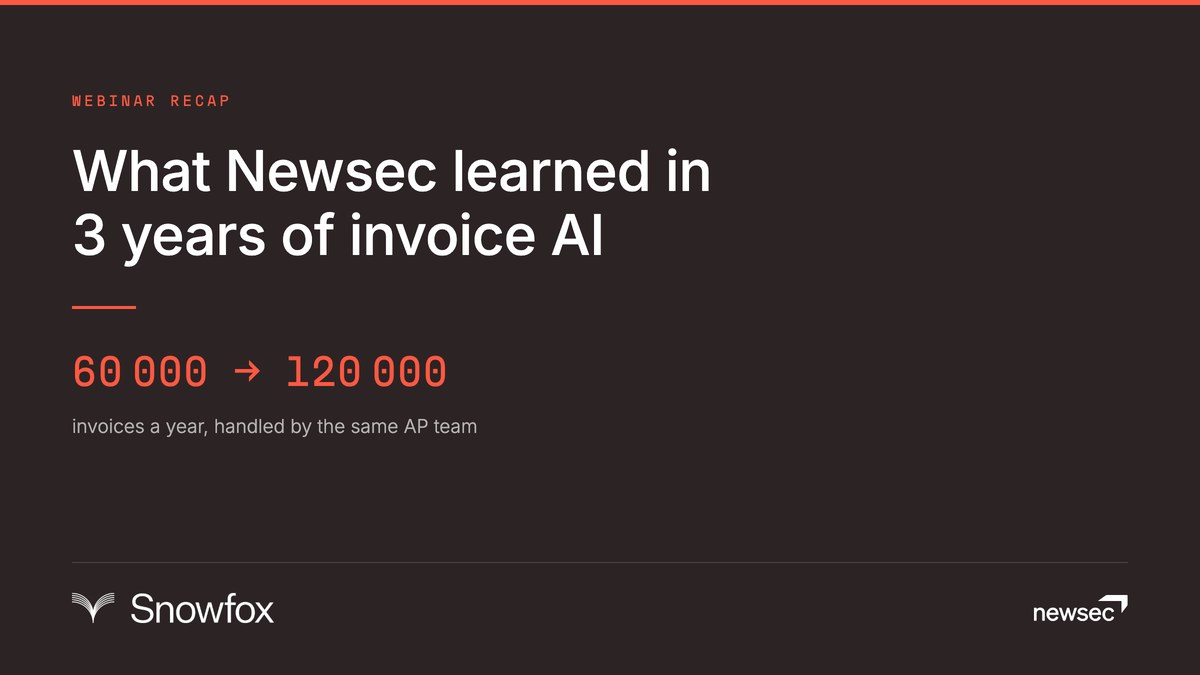
When they started with Snowfox, roughly 60 000 invoices came in each year and about 40 % of them were coded by rules. Today the figure is 120 000 invoices a year. Rules still account for 40 to 50 % and AI handles the rest.
The most interesting number, though, is this one: in AP, a single person still receives and distributes those invoices. Three years ago she handled 30 000 invoices a year. Today she handles 120 000.
Tore put the benefit in terms of growth. Reviewers and approvers have less work than they used to, because they now get a coding suggestion either way, whether it came from a rule or from the AI. That is what has let the volume double without the team growing with it.
Tore also raised a quality point that usually gets lost behind the productivity talk. The same person can code the same invoice differently on two different days, because their knowledge and their energy levels vary. AI produces more consistent data than a human does, and consistent accounting data is the foundation of all reporting.
One thing pleased us in particular: the benefit does not stay inside the building. Newsec’s own clients take part in the review flow, so they too receive invoices that arrive already coded.
Replacing people was never part of it
Odd Arne’s framing was worth writing down, because it differs from what you usually hear about AI. He described it as a practical tool rather than a goal in itself. When the menial work goes away, a colleague can focus on what actually creates value for them and therefore for the company. That costs Newsec nothing, and what it buys is a better working day, lower turnover and better quality.
This is precisely what we have been repeating for years: the work changes, but the work does not disappear. Newsec has not cut headcount. They process twice the invoice volume with the same team, and they do it better. Keeping a human in the loop is a matter of principle for them, not a technical shortcoming.
What surprised them, good and bad?
The positive surprise was how light the implementation turned out to be. Newsec first ran an accuracy test on around 20 000 historical invoices, saw the automation level in advance, and described the actual rollout as “plug and play”. In the early days they held frequent meetings to look at the numbers and work out where the AI had gone wrong. Since then the solution has run by itself with no separate maintenance beyond keeping an eye on it.
Along the way they even replaced their entire ERP: accounts and dimensions were rebuilt from scratch. That went smoothly too, which is by no means a given.
The challenge Tore raised was that this is a third-party solution sitting on top of another third-party solution. That demands genuine collaboration from everyone involved, both at rollout and in day-to-day operation. It is an honest observation, and it is worth taking seriously at the procurement stage too: ask how the vendors talk to each other.
Rules are not going anywhere
Here we owe you a concession. We write often about how rule-based automation cannot reach a high automation rate on non-PO invoices. Newsec is a good example of the exceptions: rules handle 40 to 50 % of their invoices.
The reason is the industry. In property management a large share of invoices are genuinely recurring: electricity, cleaning, monthly maintenance. Newsec can build a rule once and apply it across every entity they manage, and in that case a rule is cost-effective and exactly the right tool. The remaining invoices are annual or one-off, and building rules for those does not pay off.
This is how it should work: the system’s own automation always takes precedence, and AI handles what would otherwise be done by hand. If you feel inadequate because your rule-based automation does not reach 90 %, we can reassure you. Very few organisations reach it, and the reason is not laziness.
One thing is still ahead of Newsec: automating the approval flow. They have considered it but held back, because approvers across 600 entities change constantly and AI, by default, looks backwards. That is a fair concern, and it is exactly the kind of change the models need to accommodate in advance, through proper admin tools.
Five things to check before you commit
We closed the webinar by summarising what we would pay attention to if we were evaluating invoice AI right now:
- Make sure it is actually AI, and that you know what it is capable of. There are plenty of solutions on the market whose AI prefix does not survive closer inspection.
- Run an accuracy test on your own historical data before you commit. Newsec did exactly this, and we recommend it to everyone. Every invoice mass is different, and nobody’s general accuracy claim tells you anything about your numbers. If a vendor will not run the test, that is an answer in itself.
- Demand analytics. AI must not be a black box. Accuracy should be at least 85 % per dimension, and every prediction should come with a confidence value, meaning the AI’s own reading of how sure it is. That is how you find the one incorrect prediction among the nine correct ones.
- Demand admin tools for optimising the models. VAT rate changes, a cost centre restructure or people changing roles all need to be fed into the model in advance, not corrected after the fact.
- Demand results quickly. With a good solution you should not have to wait six months to see them.
The best advice came from the customer
The best advice of the session came from Odd Arne, though. His message to anyone evaluating AI was to get on the train, but not to chase the hype. The hype is not what matters. What matters is doing something genuinely meaningful for your own business.
And Tore’s addition to the same point: do not bite off too much of the elephant at once. Newsec did not set high expectations at the outset. They ran a pilot and learned as they went. When we asked what they would do differently, the answer was: not much at all.
If you are still coding purchase invoices by hand, we would recommend watching the full recording at the top of this post. Tore and Odd Arne’s honesty is worth hearing for yourself. And if you want to know what automation rate your invoice data would reach, book a short conversation and we will run an accuracy test on your history.